

Google Ads has always been predictive.
What’s changed is how prediction happens.
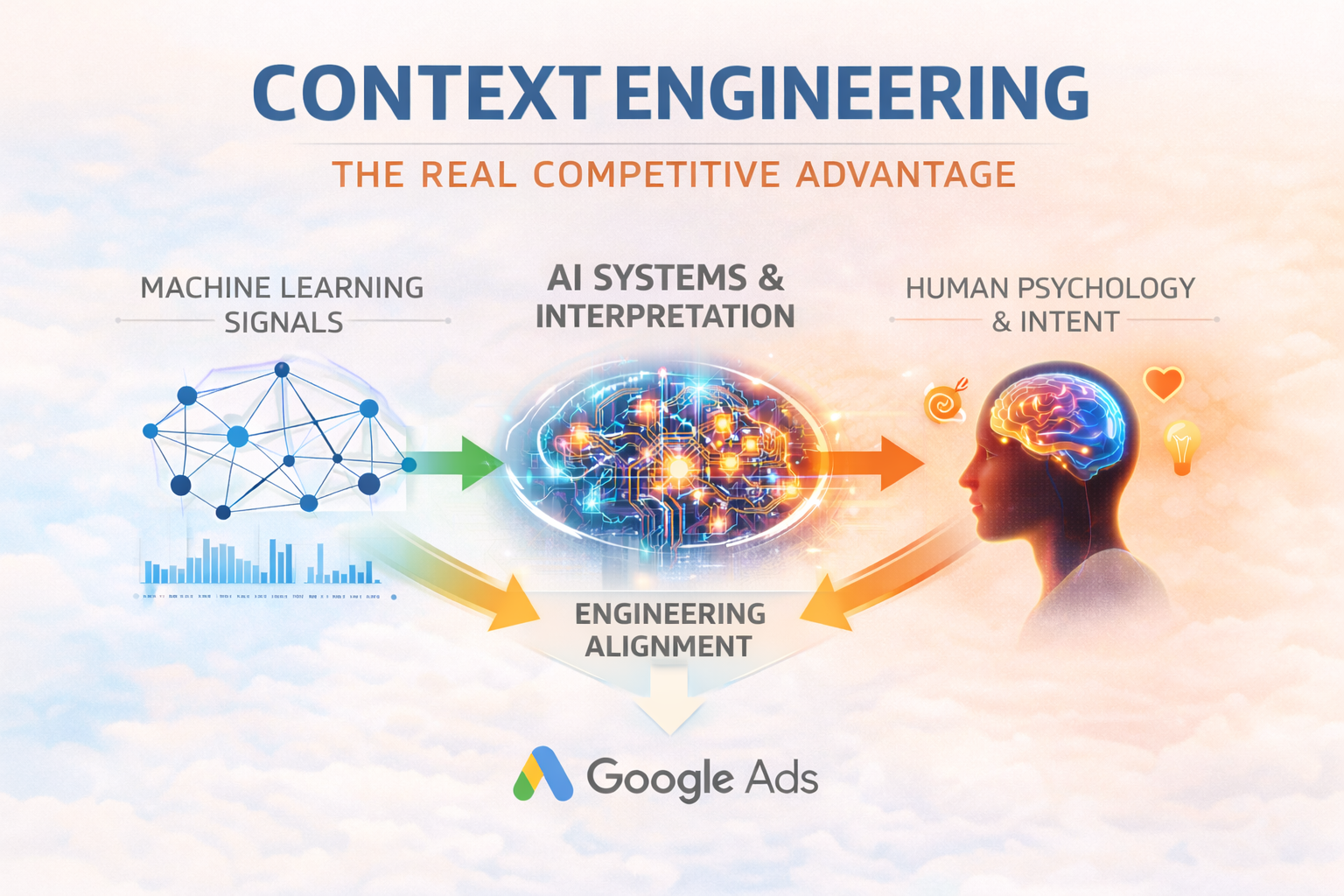
The platform has moved from rules-based execution to machine learning systems and now to AI-driven interpretation. Each layer operates differently. Each requires different inputs. Most advertisers have not adjusted.
In the rules-based era, you controlled outcomes through structure and logic.
Match types constrained reach. Bids controlled aggression. Campaign design dictated behavior.
You built the system. The platform executed it. That is no longer the world we operate in.
From Rules to Machine Learning to AI
Machine learning systems optimize based on signals. They observe outcomes, detect statistical patterns, and adjust weights accordingly. If conversion data is noisy, if audience signals are diluted, if value differences are unclear, the system learns the wrong thing, efficiently. That requires signal engineering.
AI systems operate differently. They are trained models that interpret structured context. They assemble creatives, expand audiences, infer relationships, and predict relevance based on the information environment surrounding them: your structure, exclusions, historical patterns, messaging, and intent signals.
They do not “learn your account” the same way bidding algorithms do. They operate within context. That requires context engineering. These systems are not fed the same way. They do not fail the same way. And they cannot be optimized the same way.
The Human Layer Most People Ignore
There is another dimension. Humans do not decide based on statistical weights or contextual embeddings. They decide based on psychological motivation.
Machine learning optimizes signal patterns.
AI interprets structured context.
Humans act on intent, fear, urgency, aspiration, and perceived value.
Today, those three mechanisms are not perfectly aligned. Optimizing purely for the machine can produce technical efficiency that fails to resonate emotionally. Optimizing purely for humans, loosely defined personas, and generic messaging often creates inputs that AI systems misinterpret or fail to scale.
In the future, AI systems may more closely approximate human reasoning. Optimizing for one may effectively optimize for both.
We are not there yet.
That gap is where competitive advantage exists.
The False Comfort of “Customer-First” Optimization
Most advertisers believe they optimize for their customers.
In reality, optimization often means surface-level personas, reactive creative testing, and historical performance adjustments without structured intent modeling. That is not rigorous human optimization. And it is certainly not optimization for AI systems.
Machine learning requires disciplined signal clarity. AI systems require structured context.
Humans require psychologically aligned messaging. Most advertisers systematically engineer none of these.
They layer automation on top of vague segmentation and generalized creative, and expect intelligent systems to fix structural ambiguity. In a rules-based world, that could survive.In an AI-driven one, inefficiencies compound.
What Context Engineering Actually Means
Context engineering is the deliberate design of the information environment feeding intelligent systems.
It means:
- Structuring intent so high-value demand isn’t diluted
- Removing corrupting signals before they scale
- Designing hierarchies that clarify value differences
- Building guardrails and exclusions that guide expansion
- Aligning messaging to real purchase motivations, not generic categories
- Continuously refining inputs as patterns compound
You are not just managing campaigns. You are shaping the learning environment. And in autonomous systems, learning environments compound advantage or amplify drift. Clean context compounds strength. Messy context compounds waste.
At scale, small misalignments become large financial waste.
Bridging Machine and Human Through Intent
To align machine learning, AI systems, and human psychology, you need structured clarity around purchase intent.
A well-defined purchasing intent landscape forces precision around:
- What the machine needs to see
- What the AI needs to interpret
- What the human needs to feel
When those layers are aligned, automation becomes a force multiplier. When they are not, automation accelerates confusion. This is not about regaining manual control. It is about designing inputs with intention.
The Strategic Shift
The future of Google Ads is not more levers. It is better engineering.
Machine learning demands signal discipline. AI demands contextual structure. Humans demand psychological alignment.
Advertisers who understand how these systems learn and how they differ will shape outcomes. Those who don’t will continue reacting to performance that feels unpredictable but is structurally explainable.
In an AI-driven ecosystem, advantage no longer comes from managing campaigns. It comes from engineering the environment in which intelligent systems operate.
Master the signals. Engineer the context. Align it with human motivation.
That is the new competitive edge.