

Most advertisers approach paid search with the assumption that the system is designed to help their business succeed.
It’s not.
To understand why advertisers increasingly need their own AI systems, it’s important to understand how the Google ecosystem actually works.
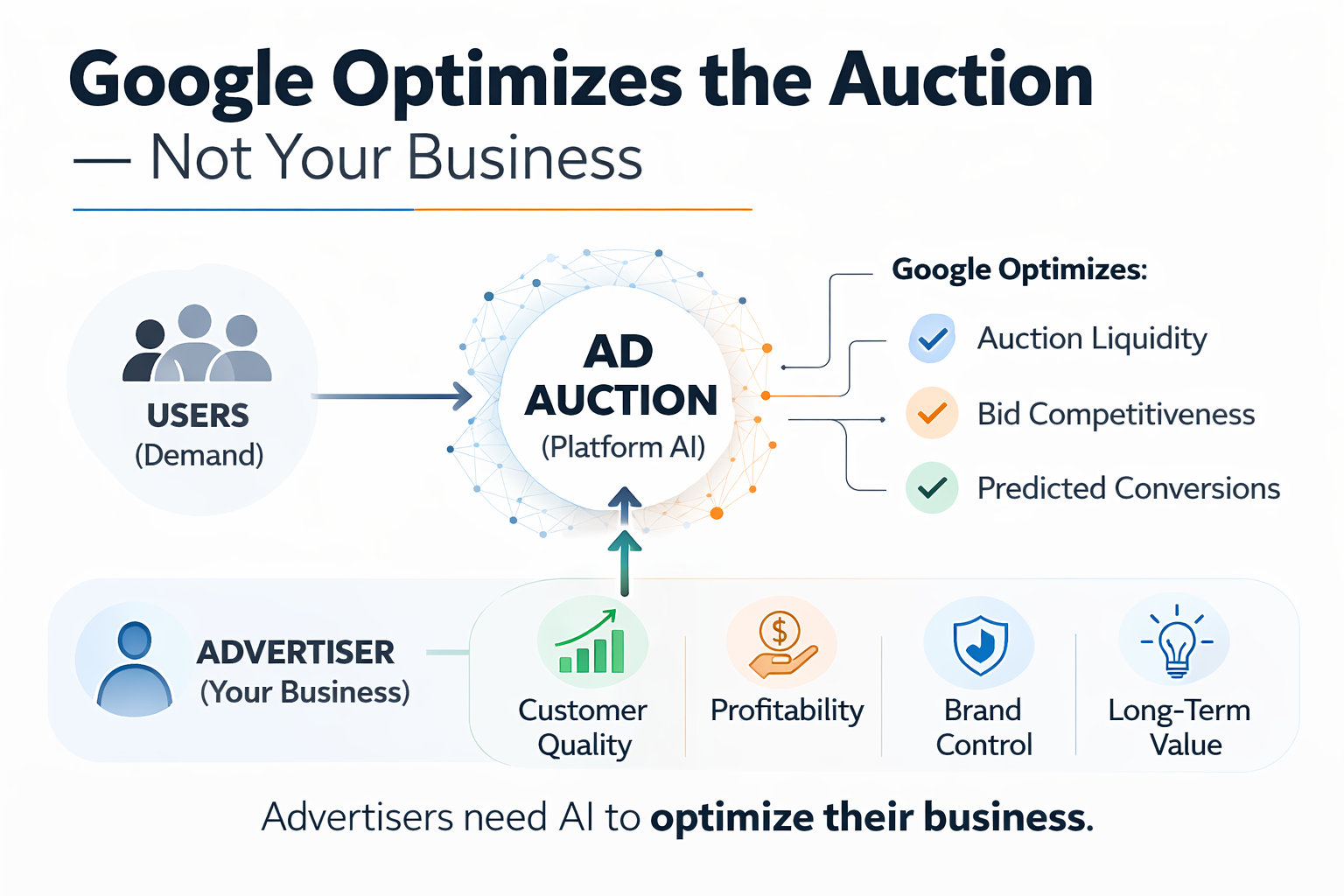 The Three Participants in the Search Ecosystem
There are three participants in every search interaction:
- The User
- The Advertiser
Each plays a different role, and each has different incentives.
The user is the source of demand. They come to Google to find answers, solve problems, and discover solutions.
Google acts as the intermediary. Its job is to deliver the best possible experience to the user while monetizing the attention generated by search activity.
The advertiser participates in the system by paying for access to that demand.
What many advertisers don’t realize is that they are the third priority in this ecosystem.
Google’s incentives are structured like this:
- Protect the user experience
- Grow and optimize Google’s monetization engine
- Deliver enough value to advertisers to maintain spending
That third point is important. Google must deliver enough return for advertisers to continue investing. But the platform is not designed to optimize the advertiser’s business. It is designed to optimize the ecosystem.
Google Optimizes the Platform, Not Your Business
Google’s algorithms are extraordinarily sophisticated, but they are not optimizing your business outcomes.
They are optimizing things like:
- Auction efficiency
- Platform revenue and yield
- User engagement and satisfaction
- Adoption of automated campaign systems
- Long-term health of the advertising marketplace
Those goals often align with advertiser performance, but they are not the same. An advertiser can achieve “acceptable” performance inside Google’s system while still leaving significant opportunity on the table. This happens when:
- The wrong audiences are captured
- Messaging does not align with intent
- Valuable demand segments are missed
- Unwanted traffic is not filtered out effectively
- Brand and regulatory constraints are not enforced
Google’s systems are designed to scale automation across millions of advertisers. They cannot fully optimize the unique strategy, positioning, and economics of every individual business.
That responsibility still belongs to the advertiser.
AI Is Reshaping the System
Over the past several years, Google has increasingly shifted toward AI-driven automation.
Campaign management is now heavily influenced by systems like Smart Bidding and automated campaign structures. These systems evaluate signals in real time and make decisions at the auction level.
As this automation increases, something important happens:
Advertisers lose direct control over many of the traditional levers of campaign management.
Instead of manually controlling every aspect of a campaign, success increasingly depends on the quality of the signals provided to the platform.
This includes:
- How audiences are segmented
- How intent is interpreted
- How content aligns with demand
- Which traffic should be excluded
- Which signals guide the system toward valuable outcomes
In other words, the battle for performance is shifting from manual execution to intelligent machine direction.
Why Advertisers Need Their Own AI
Google uses AI to optimize its system.
Advertisers need AI to optimize their outcomes within that system.
As Google’s automation becomes more powerful, advertisers need technology that can:
- understand the full landscape of purchasing intent
- Identify missed opportunities in demand
- Align messaging with real audience motivations
- filter unwanted or low-value traffic
- enforce brand and regulatory constraints
- continuously refine targeting and content signals
This isn’t about replacing Google’s automation.
It’s about directing it.
The advertisers who succeed in the future won’t be the ones who try to outsmart Google’s algorithms manually.
They will be the ones who use AI to guide the system toward their own business objectives.
The New Reality for Advertisers
Search advertising is no longer a simple marketplace where advertisers buy traffic.
It is an AI-mediated ecosystem where two intelligent systems shape outcomes:
- Google’s AI, which optimizes the platform
- The advertiser’s AI, which optimizes the business
The companies that recognize this shift early will have a significant advantage.