

When teams tell me they’re “using AI” in Google Ads, what they usually mean is they’re engaging with large language models to identify keywords, generate assets, or conduct research.
In essence, they’re managing the environment the same way they traditionally have - just using a different source for additional data, content, and ideas. The implementation of those inputs still happens manually inside the Google Ads interface, exactly as it always has.
While these tools are useful and represent a step in the right direction, they are not what’s required to operate effectively inside today’s auction environment.
Modern Google Ads no longer runs the way it did when the platform was primarily a rules-based system with levers advertisers could pull to control outcomes.
Paid search has always been complex, but the source of that complexity has shifted from advertiser-controlled rules to layered AI decision systems.
And that shift changes how the system behaves. The challenge for advertisers is that most optimization practices were developed for the old system.
What Actually Changed
The early generations of Google Ads were largely deterministic. Match types constrained reach, bids controlled aggression, and campaign structure routed traffic. Advertisers engineered the logic, and the platform executed it.
Over time, Google introduced machine learning systems to make predictions within that structure. Smart Bidding estimated conversion probability. Matching systems evaluated semantic similarity. Creative systems began predicting performance. But today the platform goes even further than prediction.
Modern Google Ads continuously reinforces and adapts its internal model of your account over time. In other words, the system is no longer just executing rules or making predictions.
It is learning what your account represents and adjusting behavior accordingly.
That’s why the architecture now operates across three different forms of intelligence.
Google Ads Doesn’t Run on One AI Mechanism
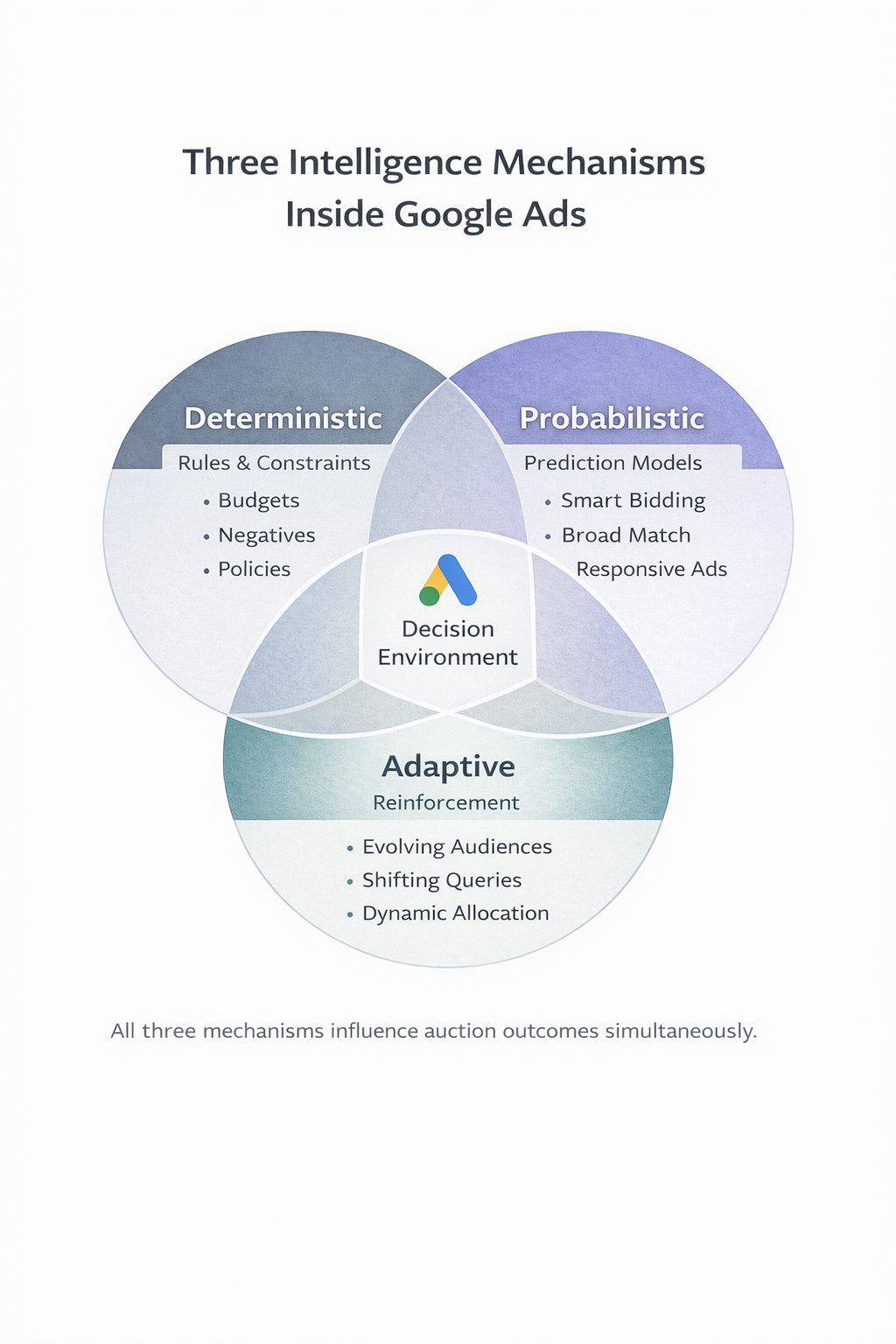
It runs on three distinct layers of intelligence stacked together:
- Deterministic logic
- Probabilistic inference
- Adaptive reinforcement
Each layer behaves differently. Each updates differently. Each requires a different kind of intervention. If you don’t mentally separate them, you end up optimizing the wrong layer and creating problems that feel random but aren’t.
There’s a simple reality behind all of this. Google uses AI to maximize revenue inside the auction. Its models predict value, allocate exposure, and reinforce patterns that increase return for their platform. Every impression decision now reflects those models’ interpretation of value.
Advertisers operating inside that system need to do the same, not by copying Google’s models, but by understanding how those models behave and designing inputs that guide them toward the right outcomes.
That starts with recognizing the three layers of intelligence you’re actually interacting with.
Deterministic: The Constraint Layer
This is the rule engine, the part of paid search that still behaves the way it did ten years ago. Budgets cap spend, negatives block queries. Geo and device targeting restrict eligibility. Conversion definitions establish what “success” means, and policy rules gate delivery.
All Binary. Non-negotiable. No gray area. Perfect for the level of intelligence at the time.
This is the layer that defines the sandbox. It doesn’t predict, it doesn’t infer, and it doesn’t learn. But if you leave it loose, such as weak negatives, vague conversion tracking, and reactive budget adjustments, then you feed polluted data into everything downstream. Loose constraints don’t create flexibility. They create training data that the rest of the system never fully recovers from.
Probabilistic: The Inference Layer
Inside that sandbox, everything becomes statistical. Smart Bidding calculates conversion probability auction-by-auction. Broad match evaluates semantic similarity. Responsive ads rank asset combinations by expected performance. Quality models estimate engagement likelihood. None of this is rule-based. It’s an inference.
The system continuously calculates the expected value using the signals you provide. If you feed it blended high and low-value intent? The model averages. If conversion values are inconsistent? The model smooths. Constant structural changes? Predictions destabilize.
Probabilistic systems don’t need more automation. They need disciplined, segmented signals.
Adaptive: The Reinforcement Layer
This is the layer almost no one explicitly names or monitors. Once probabilistic decisions run continuously, feedback loops begin to compound. The system starts reinforcing its internal model of who converts, what value looks like, which queries matter, and where exploration should occur.
Over time, the effects become visible. Audience composition drifts, query clusters expand or contract, and creative themes begin to dominate. Spend reallocates in ways that feel subtle until they aren’t.
The platform is no longer just predicting outcomes. It is updating its belief structure about your account, and that belief structure becomes self-reinforcing. Early misalignment compounds. Clean signal architecture compounds, too. In a reinforcement system, small differences in early signals often produce large differences in long-term outcomes. That’s why two accounts with similar budgets and goals can diverge dramatically over time. They trained different system beliefs.
Why This Distinction Explains Most Optimization Failures
Today, deterministic controls are only the first layer. Most performance outcomes are shaped by probabilistic inference and adaptive reinforcement. Diagnose every issue as a structural problem, and you tighten guardrails while the model remains mis-trained. Treat every fluctuation as a bidding issue, and you miss signal contamination. Ignore reinforcement dynamics entirely, and you mistake compounding drift for randomness.
Modern paid search isn’t unpredictable. It’s layered. And most teams are optimizing only one layer while the other two run unattended.
The Practical Shift
Operating Google Ads intelligently today requires managing all three layers simultaneously.
-
Design deterministic constraints deliberately tight - Create intentional boundaries.
-
Feed probabilistic systems clean, segmented signals - no blending, no noise.
-
Monitor adaptive drift and correct trajectory early - watch what the system is actually reinforcing.
This isn’t about “turning AI on.” It’s about understanding which intelligence mechanism you’re influencing every time you make a change. Until that distinction becomes part of your mental model, optimization will continue to feel volatile. Even when the system is behaving exactly as designed.
AI is not one thing. Modern paid search isn’t either. And understanding the difference is where the advantage begins.